

Short answer: collagen peptides at 2.5 to 10 grams a day for 8 to 12 weeks produce small, measurable gains in skin hydration and elasticity in about 19 mostly industry-funded trials. The joint and bone data are thinner, hair and gut claims are unsupported, and a retinoid plus daily sunscreen still has far stronger evidence for skin.
The tub in your pantry promises glowing skin, stronger nails, happier joints and a calmer gut. Some of that has been tested; most has not. Here is what the trials found, who paid, and, in the Evidence Meter below, how each promise scores.
🧪 Collagen at a glance
- What it is: collagen from cow hide or fish skin, cut into small peptides that dissolve in liquid.
- Skin: small, consistent gains in hydration and elasticity at 2.5 to 10 g a day after 8 to 12 weeks. Modest in the mirror.
- Joints and bone: a small effect on knee pain; one 12-month trial on bone density.
- Hair, nails, gut: almost no controlled evidence.
- What matters more for skin: a retinoid at night and sunscreen every morning.
What are collagen peptides, and does digestion destroy them?
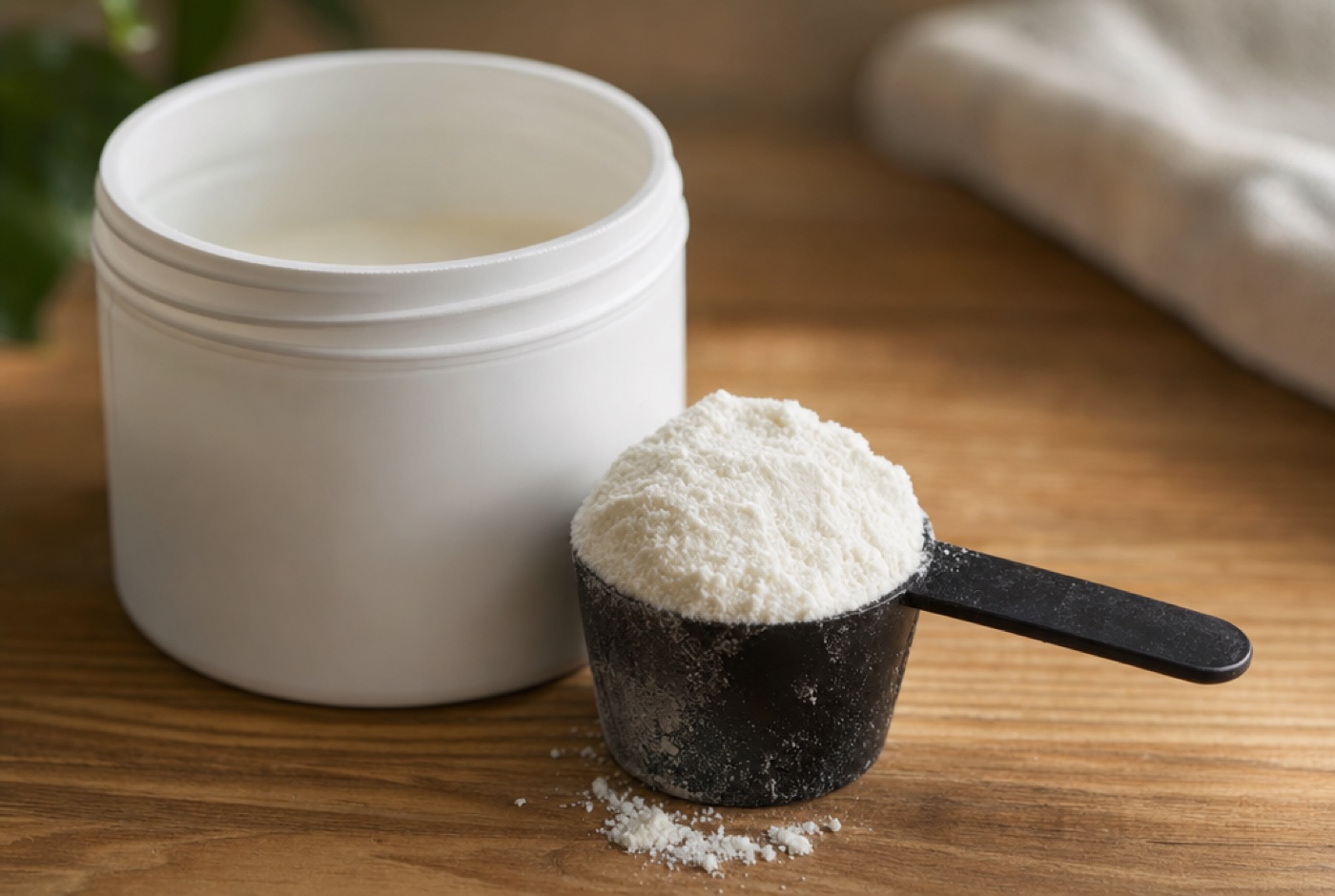
Collagen is the structural protein that makes up about three quarters of the dry weight of skin and most of the matrix in tendons, cartilage and bone. The powder in a tub is not that protein intact. It is hydrolyzed collagen, sold as collagen peptides: cow hides, bones or fish skins are boiled into gelatin, then cut by enzymes into chains of two to twenty amino acids, which is why it dissolves in cold coffee and does not gel.
The obvious objection is the one from high school biology: protein is digested into amino acids, so swallowing collagen cannot put collagen into your face. That is half right. Most of the powder does end up as loose glycine, proline and hydroxyproline. But a meaningful share survives as di- and tripeptides, especially prolyl-hydroxyproline (Pro-Hyp), which appears in the bloodstream within an hour of a collagen drink. In lab dishes those peptides act as signals, nudging fibroblasts, the cells that build skin, to multiply and make more hyaluronic acid. Whether that happens at meaningful strength in the skin of a 58-year-old drinking one scoop a day is what the trials were meant to answer.
Does collagen actually help skin?
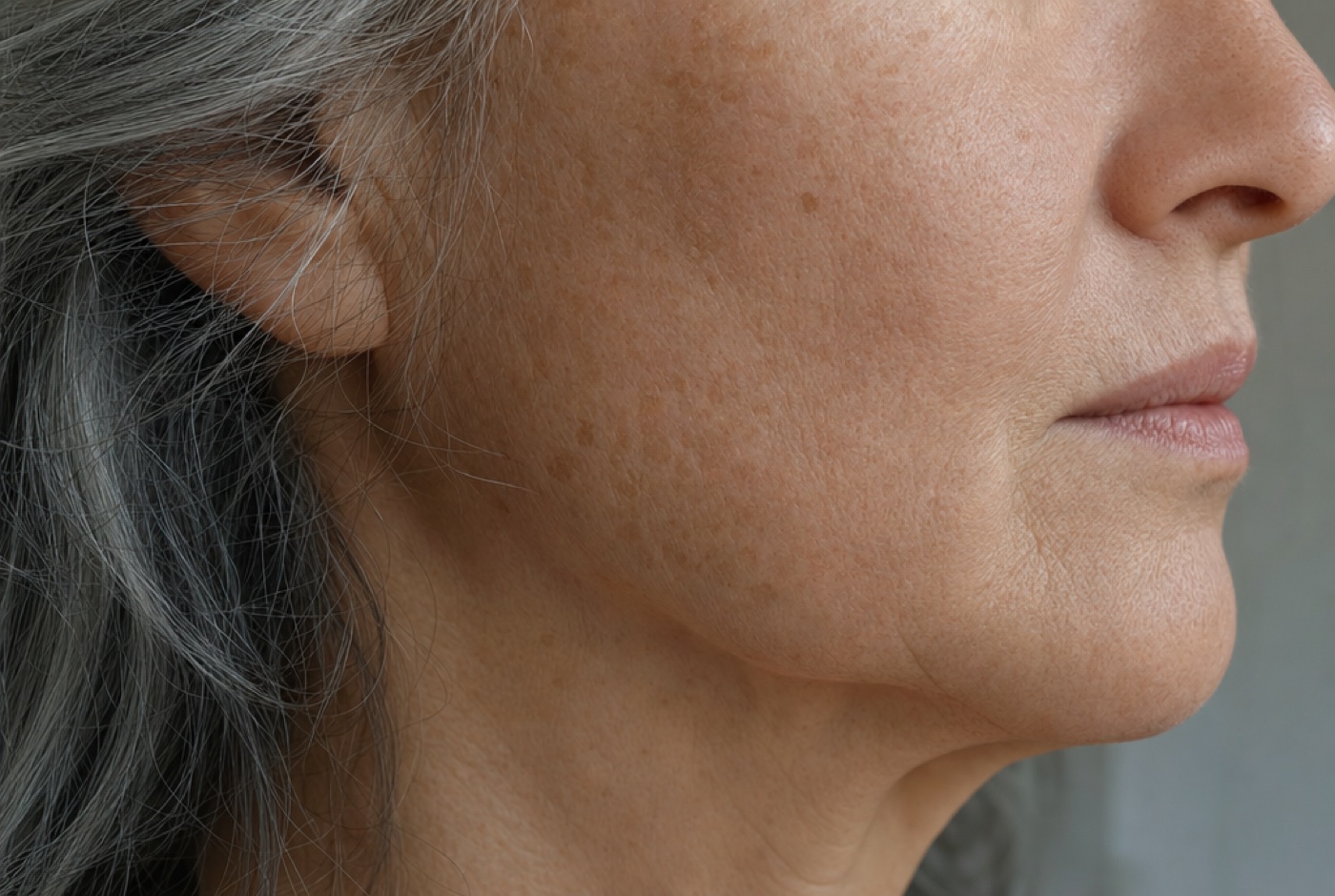
Here the evidence is real, and smaller than the ads. The best summary is a 2021 systematic review and meta-analysis in the International Journal of Dermatology that pooled 19 randomized, placebo-controlled trials with about 1,100 participants, mostly women between 35 and 65. People on collagen ended up with measurably better skin hydration and elasticity than people on placebo, at 2.5 to 10 grams a day over 8 to 12 weeks.
The single trial quoted most, published in Nutrients in 2019, gave 72 women 2.5 grams a day for 12 weeks and reported gains in hydration, elasticity, roughness and skin density. The numbers were consistent and small: elasticity up a few percent, eye wrinkles measurably but not dramatically shallower. Nobody was rated by a blinded observer as looking younger, because that was not measured.
Then the caveats. Nearly every trial was funded or supplied by a collagen manufacturer. Most enrolled fewer than 100 people. None ran longer than six months, and none compared collagen with a retinoid or sunscreen. The fair reading: collagen peptides probably do something modest for skin hydration and elasticity, in a body of research a skeptic could still call preliminary.
What about joints, bones, hair and nails?
Joints have the second-best case. Two products have been studied: undenatured type II collagen, sold as UC-II at just 40 milligrams a day, and ordinary hydrolyzed collagen at 10 grams. In a 2016 multicenter trial of about 190 people with knee osteoarthritis, UC-II beat placebo on a standard pain-and-function score by a modest margin. Hydrolyzed collagen has a scattering of small trials in osteoarthritis and in athletes, most showing a few points less pain than placebo, some showing nothing. Where the effect exists, it is in the range a walking program delivers.
Bone rests on one trial. In 2018 a German group gave 131 postmenopausal women with low bone density 5 grams of a specific collagen peptide or placebo daily for a year. Density at the spine and hip rose slightly on collagen while it drifted down on placebo: interesting, but a single manufacturer-funded study with no fracture data.
Hair and nails are where the label runs furthest ahead of the data. The one nail study, 25 people on 2.5 grams for six months, had no placebo group; for hair there are essentially no controlled trials. The gut health claim has none either. For muscle, the trials that found a benefit paired 15 grams a day with a supervised lifting program in older men; the lifting did the work.
What does not matter: type, source and “clinical strength”
Once collagen is hydrolyzed, the arguments on the front of the tub mostly dissolve with it. Type I versus type III is irrelevant, because both are cut into the same short peptides. Marine versus bovine has never been tested head to head; fish collagen costs more and suits people who avoid beef. “Clinical strength” has no regulatory definition. Most trials used peptides from a few German and Japanese suppliers; the best-selling US tubs are a reasonable equivalent, not the tested article.
How much, how long, and is it safe?
How strong is the evidence for each claim?
Seven promises, one meter. Click a claim to see the studies, the dose tested, and what realistically changed.
🔬 Collagen Evidence Meter
Pick a claim you have seen on a tub or in an ad. The meter rates the human evidence from 0 (none) to 5 (strong and consistent), and the panel shows what the trials actually did. Nothing leaves your browser.
Can you get the same thing from food?
Partly. Bone broth is a fine soup, but its collagen content is all over the map, from a fraction of a gram to several grams per cup. Plain gelatin is cooked collagen at a fraction of the price. More useful than either: the body builds its own collagen from adequate protein, roughly 0.8 grams per kilogram of body weight a day and more after 65, plus vitamin C, without which the enzymes that assemble collagen cannot work. Fix those before buying powder.
Supplements versus what you put on your skin
This is the comparison the collagen industry would rather you did not make. For firmer, smoother, less lined skin, the strongest evidence belongs to two things you apply, not swallow. Topical retinoids have decades of randomized trials, an FDA-approved prescription form for photoaging, and biopsy studies showing they increase collagen in the dermis itself, the thing collagen powder is only hoped to signal. Daily sunscreen has an Australian randomized trial of about 900 adults who showed measurably less skin aging after four and a half years. The American Academy of Dermatology’s advice on anti-aging products starts with sunscreen, adds a retinoid, and does not mention collagen supplements; dermatologists who have looked at the trials generally say the evidence is not strong enough to recommend them.
Where do the newer topical ingredients fit? Below retinoids and sunscreen, above collagen powder in plausibility, and mostly untested at the standard the retinoid literature sets. Korean skincare has pushed PDRN, a salmon-derived DNA fragment, into US creams; we compared the main options in our ranking of the five best PDRN skincare products, and the honest summary is promising small studies, not settled science. What skin at 60 and beyond responds to most reliably is boring: a barrier that is not stripped, a retinoid it has been eased onto, and sun it does not get. One of our contributors arrived there the long way around in her first-person account of trying a Korean cream instead of Botox, a good read on what changes once you stick with a routine. Collagen powder belongs in the “might help a little, will not hurt” tier, after those two.
Which collagen powder, if you want to try one?
If you want to run the experiment, buy the plainest tub with a third-party mark, take one scoop a day, and put a note in your calendar twelve weeks out. Four sold at every US drugstore or online; prices approximate as of September 2026.
Frequently asked questions
How long does it take for collagen supplements to work?
Is marine collagen better than bovine collagen?
Does collagen powder count as protein?
Are collagen supplements safe to take every day?
Sources
📚 Sources
- de Miranda et al., Effects of hydrolyzed collagen supplementation on skin aging: a systematic review and meta-analysis, Int J Dermatol (2021), PubMed: https://pubmed.ncbi.nlm.nih.gov/33742704/
- Bolke et al., A Collagen Supplement Improves Skin Hydration, Elasticity, Roughness, and Density: a randomized, placebo-controlled, blind study, Nutrients (2019), PubMed: https://pubmed.ncbi.nlm.nih.gov/31627309/
- König et al., Specific Collagen Peptides Improve Bone Mineral Density and Bone Markers in Postmenopausal Women, Nutrients (2018), PubMed: https://pubmed.ncbi.nlm.nih.gov/29337906/
- Lugo et al., Efficacy and tolerability of an undenatured type II collagen supplement in knee osteoarthritis, Nutr J (2016), PubMed: https://pubmed.ncbi.nlm.nih.gov/26822714/
- Harvard T.H. Chan School of Public Health, The Nutrition Source: Collagen: https://nutritionsource.hsph.harvard.edu/collagen/
- Cleveland Clinic, Collagen: What It Is, Types, Function and Benefits: https://my.clevelandclinic.org/health/articles/23089-collagen
- American Academy of Dermatology, How to select anti-aging skin care products: https://www.aad.org/public/everyday-care/skin-care-secrets/anti-aging/selecting-anti-aging-products