
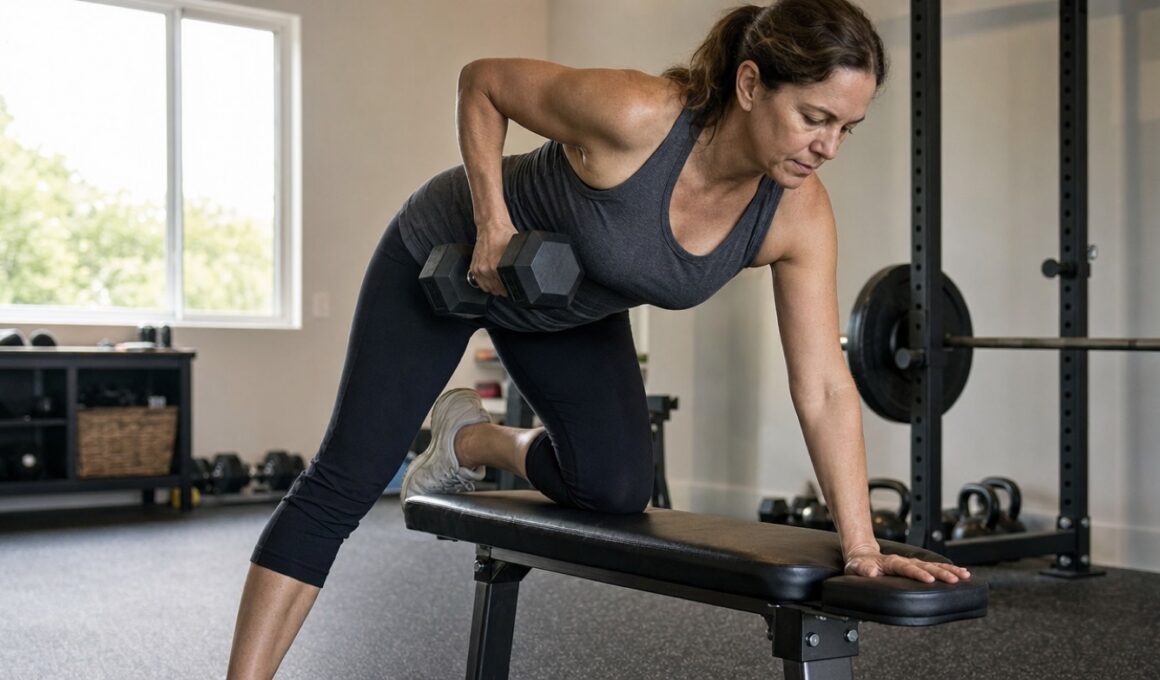
Short answer: creatine monohydrate is one of the very few supplements with solid evidence behind it, and women over 40 who lift weights are among those most likely to benefit: more strength, a little more lean mass, possibly a small boost for bone and brain. The dose is 3 to 5 g a day, every day. No loading phase required.
If you still think of creatine as the tub in your brother’s gym bag, the recent research will surprise you. Here is what it does, what it does not do, the three fears that keep women away, and, in the Creatine Dose Calculator below, your dose.
💪 Creatine after 40, at a glance
- What it is: a compound your body makes and stores in muscle to recycle fuel in the first seconds of hard effort.
- Why women: women hold 70 to 80 percent less creatine than men and eat less red meat, so their stores have room to rise.
- After 40: with resistance training, more strength and lean mass; possibly a small benefit for bone, thinking and mood.
- Not: fat loss, or muscle without training.
- Dose: 3 to 5 g of plain monohydrate a day, with a meal, rest days included.
What creatine does, and why women may respond well
Creatine is not a hormone, a stimulant or a protein. It is a small molecule your liver and kidneys make from three amino acids and store, about 95 percent of it, in your muscles. There it regenerates ATP, the energy your cells spend in the first ten seconds of anything hard: a set of squats, standing up from a low chair, catching yourself on the stairs. Top the stores up and the muscle can do a little more before it fades. That extra rep, repeated over months, is where the results come from.
It is also the most studied supplement in sports nutrition. The International Society of Sports Nutrition’s 2017 position stand calls creatine monohydrate the most effective supplement available for increasing high-intensity exercise capacity and lean body mass, and safe in healthy people at recommended doses. More than a thousand human trials sit behind that sentence.
The women’s angle is newer. A 2021 review in Nutrients by Abbie Smith-Ryan, Darren Candow and colleagues, “Creatine Supplementation in Women’s Health: A Lifespan Perspective,” pulled together what had been a footnote in studies of men. Women have been reported to hold 70 to 80 percent lower endogenous creatine stores than men, and they eat less of the foods that supply it, essentially red meat and fish. Lower stores mean more room to fill. Add the drop in estrogen around menopause, which affects muscle, bone and plausibly brain energy metabolism, and you have a group with good reason to respond well, and a decade of small trials that mostly say it does.
What the evidence shows for women over 40

Strength and lean mass: the solid part
This is where the evidence is firm. Meta-analyses of older adults, most of them 55 and up, consistently find that creatine plus resistance training beats training alone: on the order of 1 to 3 lb more lean mass and larger strength gains over 12 to 24 weeks. Darren Candow’s group at the University of Regina has run much of this work, including trials in postmenopausal women, and the pattern holds when women are analyzed on their own. The effect is modest; it does not turn a beginner into a powerlifter. It does help you keep muscle at the age when women lose it fastest, roughly 1 percent a year after 50.
Bone: mixed, and slower
The hope was that stronger muscles pulling on bone would nudge density upward. The results are mixed. A 12-month trial in postmenopausal women found that creatine plus training slowed density loss at the hip and slightly widened the femoral shaft, a geometry change that may matter for fracture resistance even when the density number does not move. A two-year follow-up found no effect on density but again some on geometry. Fair summary: possibly useful, not proven, and no substitute for training, protein, vitamin D and, if your scan warrants it, medication.
Brain and mood: promising, small trials
The brain also stores creatine. Small trials have found better short-term memory and reasoning in people taking it, with the largest effects where stores start low: vegetarians, older adults and, in a widely shared 2024 experiment, the sleep-deprived, where one large dose partly reversed the deficits of a sleepless night. For mood, a handful of trials, including one in women with depression, found creatine improved the response to an antidepressant. Not a reason to take it on its own; for a woman in perimenopause who lifts anyway, a plausible bonus.
What it does not do
Creatine does not burn fat, suppress appetite or raise your metabolism. Women who lose fat on creatine lost it through the training it helped them do. And it does not build muscle in someone who does not train; it adds capacity, and capacity has to be used.
The three fears: water weight, hair, kidneys
Water weight. This is the one that stops most women, so here is the precise answer. Creatine pulls water into the muscle cell along with it. Over the first two to three weeks the scale typically rises by 1 to 2 lb, sometimes 3 with a loading phase. That water is inside your muscle cells, which is why they look fuller rather than softer; it is not the puffy retention of a salty dinner. It does not keep climbing, and quite a few women in trials report no change at all.
Hair loss. The entire evidence base for this fear is one 2009 study of 20 male rugby players whose dihydrotestosterone, a hormone involved in male-pattern baldness, rose within the normal range during a loading week. Nobody’s hair was measured, and no study since has replicated the finding or reported hair loss. A 2021 review of common creatine questions in the Journal of the International Society of Sports Nutrition found no support for the claim. In women, there is nothing at all.
Kidneys. In healthy adults, decades of trials at 3 to 5 g a day, some running four or five years, show no harm to kidney function. Two honest caveats. Creatine breaks down to creatinine, the marker doctors use to estimate kidney function, so your labs will read a little higher; tell your doctor you take it, or you may be sent for a needless workup. And if you have kidney disease, or take medication that stresses the kidneys, talk to your doctor before you start; Mayo Clinic and the Cleveland Clinic say the same.
How much creatine should a woman over 40 take?
The dose is the least controversial part: 3 to 5 g of creatine monohydrate a day, every day: smaller women toward 3 g, larger women toward 5 g. Most trials used 5 g. More does not do more; muscle stores saturate and the surplus leaves in your urine.
Loading is optional. The classic protocol, about 0.3 g per kilogram a day (20 g for a 150 lb woman) split into four doses for five to seven days, fills the stores in a week instead of three or four. The cost is more stomach upset and a faster water-weight jump, exactly what most women want to avoid. Steady dosing reaches the same place by week four. Skip the load.
Timing is not critical. Studies looking for a best time, before training, after, or with breakfast, found differences too small to act on. Take it with a meal, the easiest habit to attach it to. Rest days count. Consistency beats timing.
Run your own numbers below.
⚖️ Creatine Dose Calculator
Body weight, steady or loading start, and whether you lift. Out comes a daily dose in grams and teaspoons, plus a realistic timeline. Nothing you enter leaves your browser.
Which creatine to buy
Buy plain creatine monohydrate, ideally micronized so it stirs into water more easily. For the tightest purity spec, look for Creapure on the label, a German-made raw material many third-party tested brands use. That is the whole shopping list; the powder tastes of nothing and costs 10 to 25 cents a serving.
What to skip: creatine HCl, buffered creatine and every “women’s” or “beauty” creatine formula. None has beaten plain monohydrate in a head-to-head trial, and they cost two to three times as much per gram. Gummies are the newest problem: independent testing in 2024 and 2025 found several popular brands delivering a fraction of the labeled dose, because creatine degrades in a wet, acidic gummy. If you cannot stand powder, capsules are the fallback, though 5 g means six to eight of them.
⚠️ Five mistakes that waste the tub
- Taking it only on training days. Stores drain slowly; a daily dose keeps them full.
- Quitting in week two because the scale went up. That is water inside your muscle cells, arriving on schedule.
- Paying triple for HCl, buffered or “women’s” formulas. Same molecule at best, less of it at worst.
- Expecting results without lifting. Creatine adds capacity; training turns it into muscle.
- Not telling your doctor before blood work. A higher creatinine value is expected, if the reader knows why.
Frequently asked questions
Will creatine make me gain weight?
Does creatine cause hair loss in women?
Is creatine safe for my kidneys?
Do I need to take creatine on rest days?
Sources
📚 Sources
- Kreider RB et al., ISSN position stand: safety and efficacy of creatine supplementation, J Int Soc Sports Nutr 2017: https://jissn.biomedcentral.com/articles/10.1186/s12970-017-0173-z
- Smith-Ryan AE, Cabre HE, Eckerson JM, Candow DG, Creatine Supplementation in Women’s Health: A Lifespan Perspective, Nutrients 2021: https://www.mdpi.com/2072-6643/13/3/877
- Candow DG et al., Effectiveness of Creatine Supplementation on Aging Muscle and Bone, J Clin Med 2019: https://www.mdpi.com/2077-0383/8/4/488
- Antonio J et al., Common questions and misconceptions about creatine supplementation, J Int Soc Sports Nutr 2021: https://jissn.biomedcentral.com/articles/10.1186/s12970-021-00412-w
- Mayo Clinic, Creatine: https://www.mayoclinic.org/drugs-supplements-creatine/art-20347591
- Harvard Health Publishing, What is creatine? Potential benefits and risks: https://www.health.harvard.edu/exercise-and-fitness/what-is-creatine-potential-benefits-and-risks-of-this-popular-supplement
- NIH Office of Dietary Supplements, Dietary Supplements for Exercise and Athletic Performance: https://ods.od.nih.gov/factsheets/ExerciseAndAthleticPerformance-HealthProfessional/